
Time period
Furnish Kids – Fast Urban Responses for New Inclusive Spaces and Habitat
- Italy Milano
- Spain Barcelona
Summary
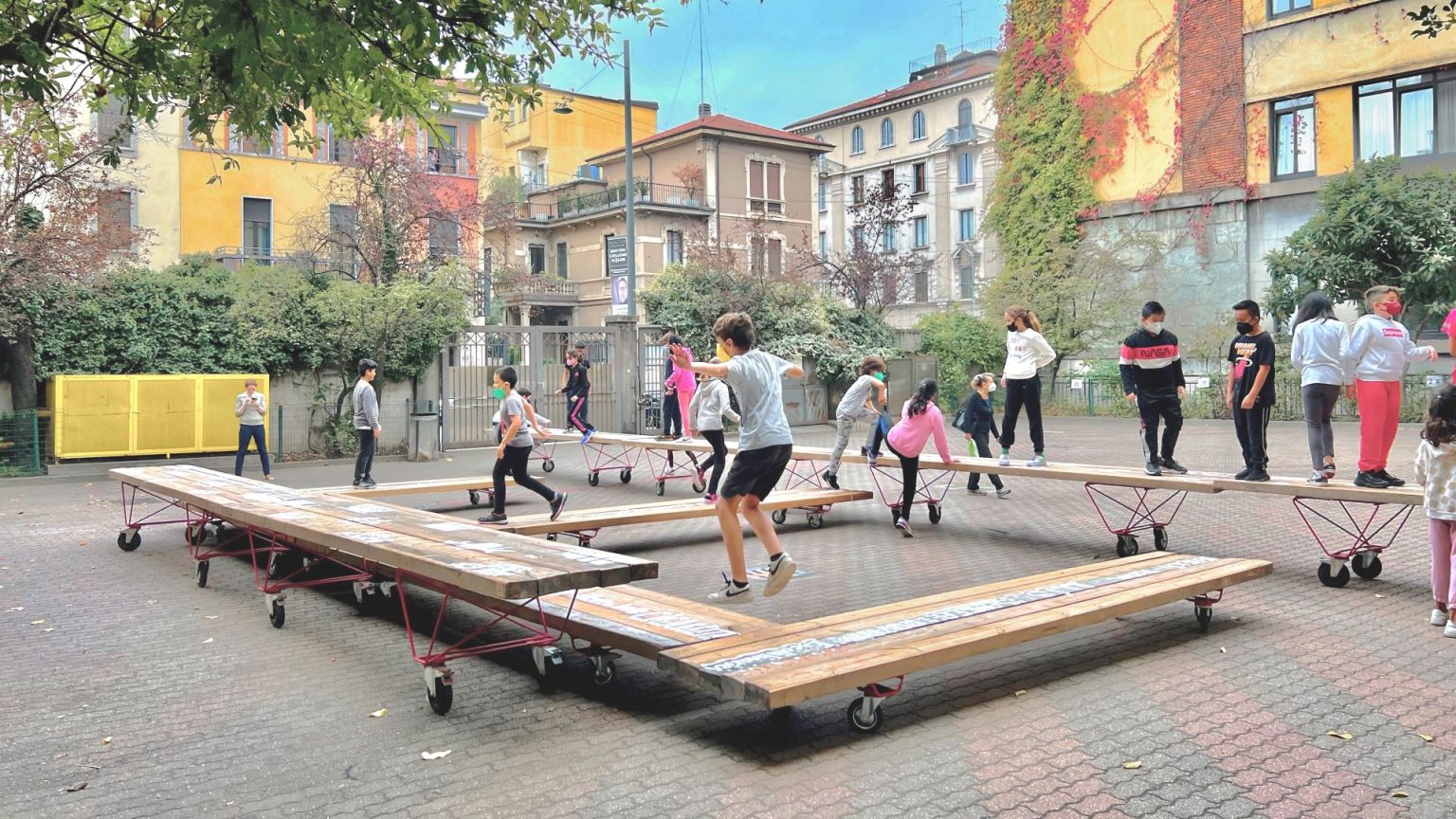
The FURNISH‑KIDS project, developed under the EIT Urban Mobility framework, explores how newly reclaimed urban spaces—previously occupied by cars—can be redesigned to better support children’s use, play, and everyday wellbeing. Implemented in Milan and Barcelona, the initiative builds on the Urban Living Labs (ULL) methodology to develop child‑friendly public space interventions through co‑creation with local communities.
Focusing on children aged 6–12, the project combines participatory workshops, prototyping, and real‑world testing to develop Mobile Urban Elements (MUEs) that activate neighbourhood spaces and encourage diverse forms of play and interaction. These prototypes are deployed and evaluated in situ, positioning children as active contributors throughout the entire process.
By linking tactical urbanism, co‑design, and experimentation, FURNISH‑KIDS enhances liveability, safety, and social interaction, while fostering local knowledge and a sense of belonging. The project demonstrates how integrating children into urban design can support more inclusive and resilient public spaces.
Key aspects
-
Reclaiming public space through mobility transition
Builds on the shift from car dominated streets to pedestrian environments, activating new public space for children’s use. -
Urban Living Lab and iterative prototyping
Applies an iterative cycle of co design, prototyping, testing, and evaluation in real urban settings. -
Co creation as a learning by doing process
Engages children and communities across all stages—from ideation to fabrication—ensuring user created outcomes. -
Inclusive and resilient urban design
Focuses on child centred, adaptable interventions that support wellbeing, social cohesion, and long term sustainability.