
Summary
The Healthy School Food Environment Pilot explores how improvements to the public realm around schools can support healthier habits and everyday wellbeing, aligning with Bogotá’s commitment to tackling childhood obesity and promoting health equity.
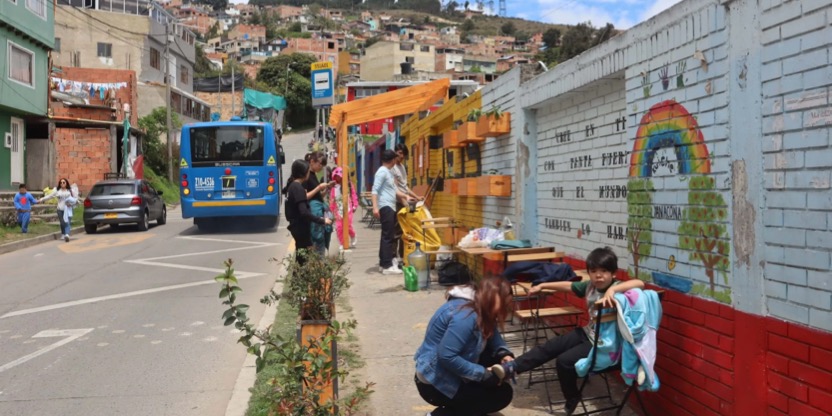
Building on a foodscape assessment developed by Cities for Better Health, Gehl— in partnership with Bogotá’s Health Secretariat—co‑developed a pilot with students, teachers, and the local community, focusing on highly used spaces such as sidewalks and bus stops around Monteverde School to encourage healthier routines.
The resulting interventions combined spatial upgrades and educational elements, including seating, shelters, an educational mural, and a vertical garden. The pilot led to increased healthy eating, improved perceptions of safety, and higher levels of active mobility, demonstrating how place‑based interventions can foster healthier behaviours, create more welcoming environments, and support more vibrant public life.
Key aspects
-
Public space as a health enabler
Revisions highly active public spaces - such as school surroundings and bus stops to support healthy food habits and everyday wellbeing. -
Evidence based approach and decision making
Builds on foodscape and life experiences assessment to inform targeted spatial interventions and cross sectoral action. -
Participatory co design with community
Engages students, teachers, and residents to shape pilot interventions. -
Place based behavior change
Uses tactical interventions to influence food choices, safety perception, and active mobility patterns.